I've been thinking a lot about the fact that most of what we learn about media, or anything at all, comes from the Media itself. In class yesterday we talked again about Rupert Murdoch and the vast amounts of media outlets that he owns. The question came up, why does one need to own exactly that much? The first thing I came up with was power and control. Rupert Murdoch can use what he controls to make people think what he wants them to think about whatever he wants, and that's both pretty cool and pretty scary. Real post on this muuuuuuuuuch later (who knew school work takes up so much time?), but for now, look at the above cartoon from the awsomely cool website toothpastefordinner.com that kind of sums up what I was thinking of, and hopefully gives you something to think about too. If you can't read what the newspaper says, it says "Mass Media not Harmful: 'Read more newspapers', scientists said Monday". Very interesting newspaper headline, I think.
Well, I actually thought I'd never update this blog again, but here I am with something to say. Not as academic or thought provoking as my other entires, since my brain isn't used to thinking like it used to after that long break.
So a few days ago, I was watching the Colbert Report like I do many mornings. And who should the guest be but that guy who wrote that book I had to read for class. You know the one, Free Culture by Lawrence Lessig. I paid a little more attention, because I actually wanted to know what he had to say.
He was talking about his new book, Remix, which has the same theme as most of his work, copyright laws, and how they're outdated. He told Stephan Colbert that his show was like taking other peoples' work, and remixing it to create his own. He also talked about how that's exactly what young people like to do , and he's right, I love doing that. As with how it usually works on the Colbert Report, Lawrence Lessig was interupted several times, but I believe he made his point pretty well.
One thing that stuck with me was how he said that copyright laws are making kids into criminals, and yet they still don't work. He talked about the war against illegal downloading that has been "fought" for such a long time, and yet everybody still does it. Of course, Stephan had to be his hillarious self and remark that Lessig was saying because of illegal downloading, 9/10 kids are now in jail.
Generally things like that leave the guests flabbergasted, but Lessig just remarked that it is a kind of a jail, because there are laws that trap them into not being able to be creative without breaking the law. Stephan Colbert then got into the topic of remixing (taking someone else's work and using parts of it to make your own). Stephan Colbert took Lessig's book and said that if he were to write his own name on the book and add some Mickey Mouse ears, it would now be his own work, and Lessig should let him do it. Of course Lessig said that was great, since that is after all the whole point of his book.
Stephan Colbert continued to see that he is not like Lawrence Lessig, and no one can ever ever remix anything of his. While this was an extremely funny segment, it couldn't have been done in a more appropriate venue. So why this long recap? Well, if I didn't just spend way too much money on tuition and school books, I'd want to buy Remix, and see what else Lawrence Lessig had to say. And if anyone who happens to read this isn't as monetarily challenged as I am right now, they should look into reading it.
P.S. If anyone wanted to remix anything in this blog, go for it. I like what I write to be enjoyed and possibly inspire other creativity.
If you want to read a book, you can just go to a local library and get it, right? Well sadly in some cases the answer to this is no, you can’t. For decades people have petitioned to get books removed from library shelves, and even bookstores. They say these books are too violent, to sexual, or contain satanic references. Many of the books most frequently banned in the late 20th and early 21st century are among such popular works of literature as the Catcher in the Rye, The Adventure of Huckleberry Finn and the Harry Potter Series. All over the country, and in fact all over the world, many people, often concerned parents, try to limit everyone’s access to certain information. This includes whoever may be reading this blog.
This has become so prevalent that the last week of September is now Banned Books Week. The dates for this week in 2009 are September 26 to October 3, and the purpose of this week is to celebrate the freedom everyone has to not only have their own ideas, no matter how crazy, but also to have access to a wide variety of ideas, even those contradictory to their own. “One of the most cherished freedoms in a democracy is the right to freely participate in the “marketplace of ideas.” (Stauber and Rampton). This marketplace of ideas is not possible if people keep taking books off the shelves, denying people access to great works of literature simply because they deem them to be inappropriate. In many cases these challenged books are not banned because officials in charge of such decisions realize that we have the right to information. Many books, however, are banned, and some people have that right taken away from them.
Banned book week started in the states 27 years ago to remind Americans not to take for granted the fact that they have the freedoms to read whatever they want. It has spread into other democratic countries because they all take for granted how unique the enormous access to information they have actually is. There are very few places in the world where you can read books presenting such a variety of viewpoints. Yet in North America especially, we take that freedom for granted until someone tries to take it away in the form of book banning. “Granting archives and libraries a broad freedom to collect, claims of property notwithstanding, is a crucial part of guaranteeing the soul of a culture.” (Lessig, 185). One of the wonderful things about our culture is the large collection of information we have, and the fact that everyone can access it. When book banning starts to happen, that is no longer true.
So the important question is, how can we help? What can we do to stop book banning from happening? One good thing to do is to read frequently banned books yourself, or recommend them to your friends. The list of 100 most banned books of the 1990s is a good resource for this. Stay informed; make sure you know if a piece of literature is being challenged at your local library “The ALA Office for Intellectual Freedom estimates they learn of only 20 to 25 percent of book challenges. Let us know if there is a challenge in your community. Find out what the policy is for reviewing challenged materials at your school or public library.”(American Library Association) There is also the Intellectual Freedom Action News (IFACTION) e-list, which is good to join if you want to show your support. The most important thing is to get the word out. Tell everyone you know how important the freedom to read what you’d like is. Write letters to the mayor or your MPP or MP telling them how important the freedom to read and asking them to proclaim “Banned Books Week – Celebrating the Freedom to Read.” This blog for me was the first step in doing my part; anyone who reads this blog will have gotten the message, and will hopefully pass it on.
"All censorships exist to prevent anyone from challenging current conceptions and existing institutions. All progress is initiated by challenging current conceptions, and executed by supplanting existing institutions. Consequently the first condition of progress is the removal of censorship."--George Bernard Shaw, Preface to Mrs. Warren's Profession
Works Cited
Lessig, Lawrence. Free Culture. New York, USA: The Penguin Press, 2004.
Stauber, John, and Rampton, Sheldon. Toxic Sludge Is Good For You! Lies, Damn Lie and the Public Relations Industry. 1st ed. Monroe, Maine: Common Courage Press, 1995.
"Banned Books Week: Celebrating the Freedom to Read." ALA - American Library Association. 2008. American Library Association. 22 Nov 2008 .
Where do we find advertisements? Do we find them on TV, billboards, in magazines? The true answer is they’re everywhere. Every step you take when walking outside is a step bombarded with images telling you to buy something. It seems like every message we get is concerned with what product we have to get next. It seems issues that really cause suffering, such as homelessness, poverty, and human rights violations are pushed away by this rush to consume. “Many public issues and social voices are pushed to the margins of society by market values and commercial communication, making it difficult to get the attention of those living in the "walled gardens" of consumerism.” (CCCE, 1). Culture jamming was created as a kind of a way to remedy this problem. Those who participate in culture jamming say that since society is saturated with branded images or icons, they will use these same branded images as vehicles for their social messages.
Take the image above right for example.
Everyone is familiar with the logo for FedEx. It symbolizes a way to get packages quickly from one place to another. Anyone who sees this logo will automatically make this identification. One could argue that this logo constitutes a symbol which “are the images we use to represent concepts, ideas and philosophies.” (McCloud, 27) If that is the case, then what is the original FedEx logo really trying to represent? FedEx reinforces the consumer culture that culture jamming is trying to represent; it implies that what we need is lots and lots of stuff, and we need to get it fast. Culture jamming attempts to make this true ideology so transparent that someone viewing this image would question what FedEx is really about.
FedUp – With excess: a simple statement but it has much greater implications. Firstly it makes clear that FedEx is contributing to our culture of excess. No longer does great distance from the products we want to buy prevent us from buying them. FedEx allows us to buy anything from anywhere in the world, and get it quickly. “Many culture Jams are simply aimed at exposing questionable political assumptions behind commercial culture so that people can momentarily consider the branded environment in which they live. (CCCE, 1).” This is exactly what this culture jam will do. People who see it almost have no choice but to stop and think. They will ask themselves, what does this mean? Why is it written? Culture jamming requires people to actually think, and come to the realization that we live with excess everyday, and FedEx and other companies will contribute to its continuation unless we let it be known that we are fed up.
Culture jamming is one of the most effective ways to get the message out there on social issues. Sure, whoever is responsible for this culture jam could have written a page about how FedEx contributes to over consumption and how that is so. The problem with doing things in writing is that it doesn’t catch peoples’ attentions. People are more likely to pay attention and be affected by things that are visual, as opposed to written. “Pictures, to be sure, are more imperative than writing; they impose meaning at one stroke, without analyzing or diluting it.” (Barthes, 110) In using this familiar logo to get the message across it is even more effective. People already have context when it comes to the FedEx logo. There are already particular associations produced so that one viewing this message in the form of a culture jam would be more likely to understand it.
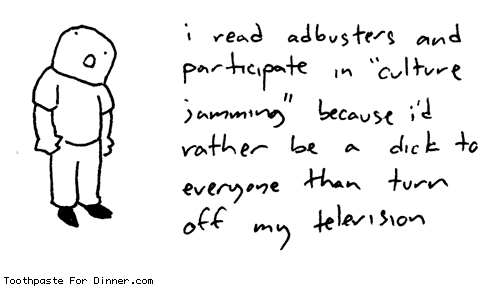
I leave you with this comic about culture jamming, which will hopefully remind you that viewing culture jams is only the first step. The next step must be doing something, even something small, to spread awareness about social issues. It is also important to remember that culture jamming isn’t about going against corporations, but about bringing to light their issues.
Works Cited
McCloud, Scott. Understanding Comics: The Invisible Art. 1st. New York, USA: HarperPerennial, 1994
Barthes, Roland. Mythologies . 1. New York: Hill and Wang, 1972.
Nobody really owns the Internet, right? I mean, how is it possible to own something so vast that contains such a large quantity of information?
Well the answer, for now, is that nobody owns the Internet. Anyone can put anything they want (and I do mean ANYTHING) online for little or no cost. There is a free flow of information, with the people producing the content no different than the people consuming it. If you wanted to video tape yourself talking about issues your passionate about while playing Sum 41 (totally random example), then put it on YouTube for millions of people to possibly see, then more power to you.
Such a thing would be impossible in the "traditional" media of television or newspaper. If you wanted to start a TV station, you'd need billions of dollars and a lot of help. All you need to post whatever you want on the Internet is a computer and an Internet connection. Big companies that used to be in charge of what media texts you consume, such as cable companies, saw that the Internet could give you for free much more than they could, and it scared the hell out of them. They saw that they were losing their control over the media, and they saw the Internet as an opportunity to regain that.
In essence, that is what net neutrality is. It makes you and me equals in terms of what we can access on the Internet, and what we can contribute. http://www.savetheinternet.com/ supplies a very practical definition. "Net Neutrality prevents Internet providers from blocking, speeding up or slowing down Web content based on its source, ownership or destination." Basically it's the principle that allows everyone equal access to the Internet.
After reading all this you might be thinking, as Ian Reilly often puts it:
WTF?!?!?!?!?!?!?!?!?! Well don't worry, hopefully after my blog post, everything will be clear. Firstly, the Internet has tremendous possibilities to aid in democratic processes. In a democracy, anyone is allowed to think anything. With the Internet, these thoughts can be heard by the masses. The Internet makes it easier to get your message out there, but it also does something more. The Internet creates a participatory culture, a two way culture where the consumer, after consuming content, goes on to contribute. "the technologies of communication will serve to enlarge human freedom everywhere, to create inevitably a counsel of the people." (Stauber and Rampton, 195) With the technology available to us the common phrase 'by the people, for the people' takes on a whole new meaning. When there is net neutrality, the Internet becomes a platform for ideas in which truly anyone can participate.
There is, however, a darker side to this new realm of possibility. Corporations who fear losing their control over what kinds of content you see in the media are thinking of charging to post certain things online, or accessing certain websites. They want the Internet to function more like television in that what you get is very controlled and costs you money, and only a very elite group can have their voices heard. People who use the material that others have the copyright too are already being called "pirates" and "thieves". "My fear is that unless we come to see this change, the war to rid the world of Internet “pirates” will also rid our culture of values that have been integral to our tradition from the start." (Lessig, 26) Here Lessig is referring to the right to free speech, and the fact that the government can't sensor any speech. He is, of course, against people blatantly using the copyrighted work of others. His fear, however, is the collapse of net neutrality. If you put restrictions on what one can or cannot do online, eventually no one will be able to do anything.
The biggest problem with the fact that net neutrality is threatened is that nobody knows about it. The fact that I'm posting this online, right now, for free, wouldn't be possible if it wasn't for net neutrality. Hopefully this blog entry at least gets the word out. Although I wouldn't say I'm IN love with the Internet, I do love it. I love it just the way it is, and I don't want it to change. If this keeps being an invisible issue the floodgates of information opened by the Internet will be closed forever.
Works Cited
"Frequently Asked Questions." Save the Internet: Fighting for Internet Freedom. Free Press Action Fund. 12 Nov 2008 http://www.savetheinternet.com/.
Lessig, Lawrence. Free Culture. New York, USA: The Penguin Press, 2004.
Stauber, John, and Rampton, Sheldon. Toxic Sludge Is Good For You! Lies, Damn Lie and the Public Relations Industry. 1st ed. Monroe, Maine: Common Courage Press, 1995.
This is what it says under the website title of Fanfiction.net. Fanfiction is the writing of fictional stories based on the fictional world created in movies, TV shows, and books. I joined this website about 5 years ago when I decided to combine my love of writing with my love for the TV show Charmed. I always wanted certain things to happen next, or I had certain theories about what had happened, so I would write stories based on this. Fanfiction is also a great way to expand upon the world created by their favorite mediums.
In one of the largest categories of http://www.fanfiction.net/, the Harry Potter category, there are 377, 767 stories. It's possible to find many stories based on any fictional work in a variety of mediums. Some of these stories are horribly written, others can be considered masterpieces. Some stories are written by 13 year old middle schoolers, which is what I was when I started, and others are written by adults with full time jobs. The great thing about fanfiction is that it allows you to do more than passively enjoy a television show or a book. You can contribute, and participate to this medium that you love.
Fanfictions have been called by critics mere copying of an original work. Those who write fanfiction have been told they have no creativity, and they are merely stealing ideas from another writer. "The situations into which the product of mechanical reproduction can be brought may not touch the actual work of art, yet the quality of its presence is always depreciated." (Benjamin, 3) In many cases, fanfiction has little to do with the actual stories being presented, and only borrow a certain element, always giving credit to the original author. Since fanfiction by definition comes from another work, it's usually not appreciated for its own merit. Fanfiction can be considered artwork all its own, but it is always tainted with its association with the original
When I write fanfiction, I often take advantage of the ambiguous and unknown factors that are always left in television shows. If a show starts with the characters being in their 20s, I use fanfiction to explore what they may have been like as teens. If the characters speak about going somewhere, but their journey isn't actually shown, I like to use fanfiction to explore their possible journey. "This phenomenon of observing the parts but perceiving the whole has a name. It's called closure" (McCloud, 63) We perform closure when watching television for example, because certain events are left out, but we are supposed to assume that they happened. "Nothing is seen between the two panels, but experiences tells you something must be there." (McCloud, 67). That thing that must be there but is never seen is what is hinted at by fanfiction.
Audiences rarely watch or read anything passively. There is always a thought process going on. It's common to theorize what might happen next week, or to try to make sense of what had happened. Fanfiction takes that one step further. You take all the what ifs and form them into your own creative stories. Fanfiction has also formed a kind of community. It's very easy to read other peoples' stories, give them feedback in the form of reviews, and for them to in return read your feedback and make changes. It is a way to both get your writing out there, and to actively engage in your favorite fiction universe.
Fanfiction would not exist if people just watched television or movies and accepted what they see. Everyone has questions or ideas about their favorite shows, because everyone creates their own meaning from media texts. "This current theory on audience reception in media studies takes into account the individual members of the audience. It realises there is a preferred meaning in the text, but also places emphasis on the audience in the process of constructing a meaning." (Hanes) Writing stories based on media texts is just yet another way to create meaning from texts.
Fanfiction.net once said "Unleash your Imagination, and Free Your Soul." This is the perfect definition for the purpose of participatory culture. Fanfiction is more than something based on an original work; it's a way to let lose all of your creativity.
Works Cited
McCloud, Scott. Understanding Comics: The Invisible Art. 1st. New York, USA: HarperPerennial, 1994
That's the focus of society today. Without the latest "thing" we are effectively left behind in the societal race. We are never satisfied with the "stuff" that we have, so that's what we want: More stuff. I doubt I could go more than one day without buying something, and even that one day is a little hard. Buying nothing means no coffee, no fast food, no bus tokens. Difficult, but it can be done. In fact, on Friday, November 28, 2008, it is Buy Nothing Day.
This is the day after American Thanksgiving, which is traditionally the busiest shopping day of the year. Many argue that one day of not buying anything won't make a difference to the alarming over consumption practiced routinely in North America today. They're right, it doesn't make much of a difference. However, adbusters, who started the day said ""isn't just about changing your habits for one day" but "about starting a lasting lifestyle commitment to consuming less and producing less waste."
But what makes a change in consuming habits really necessary? I mean, what makes our consumerism so bad? Well maybe you'll see the necessity for a day to buy nothing by watching this youtube video.
We are told to buy things all the time, whether from commercials by companies wanting to make money, or by politicians who tell us it will help the economy. In fact, it is the over consumption practiced in North America that leads to an excess of waste, and a lack of focus on the things that really matter.
Firstly, if there is such a dependence on money and what one can buy in society, there is a class division that increases between the haves and have nots. Suddenly people who can afford to buy all the latest products is somehow better than those who cannot. It is almost impossible to break out of this cycle, because the majority of people will only listen to those with power, and in a society of consumption, those who have the power also have the money.
"they come from a small section of the bourgeoisie itself, from a minority group of artists and intellectuals, without public other than the class which they contest, and who remain dependent on its money in order to express themselves." (Barthes, 139)
The only way to fight against our tendency to buy much more than we need for no good reason is to recognize our dependence on our possessions, and make a constant effort to buy less. So next time you're really tempted to buy that latest cell phone even though you have one that works perfectly fine, or that new iPod just because everyone else has one, it's important to ask yourself one simple question. Do I really need that? Why do I need that. If you realize that you have no good reason, maybe it's better not to buy.
Those who often have the most need for such basic things such as food, shelter, and medication, are often those who consume the least. "those who most need the mass produced goods- and this includes food, medicine, and clothing - do not have the means to purchase the very items they often make." (Franklin, 162) It is very telling that the places that have the most need for necessities, such as India, South America, and Africa, consume the least. While here, in North America, we need the least, yet we consume the most
So no, you do not need whatever that latest thing you saw on TV is. In fact, if you think of it, very little of what you have you actually need. Would anybody actually die without their laptop? They wouldn't die, they just might be a little upset. Buy nothing day is to give us some perspective about the amount of consumerism that we do, and how damaging it could be. If we go for a day without relying on our dependenceconsuming, maybe we could go two or three, or even cut down on our consumption on a daily basis. We are more than what we buy.
You can never get enough of what you don't need to make you happy. ~Eric Hoffer
This started as a mandatory class excersise (those posts are still there). It has become a place where I rant about what I read in the newspaper, new technologies, and media phenomena that just plain bug me. If the general public would like to know the media related things that pass through my head, here's the place.